
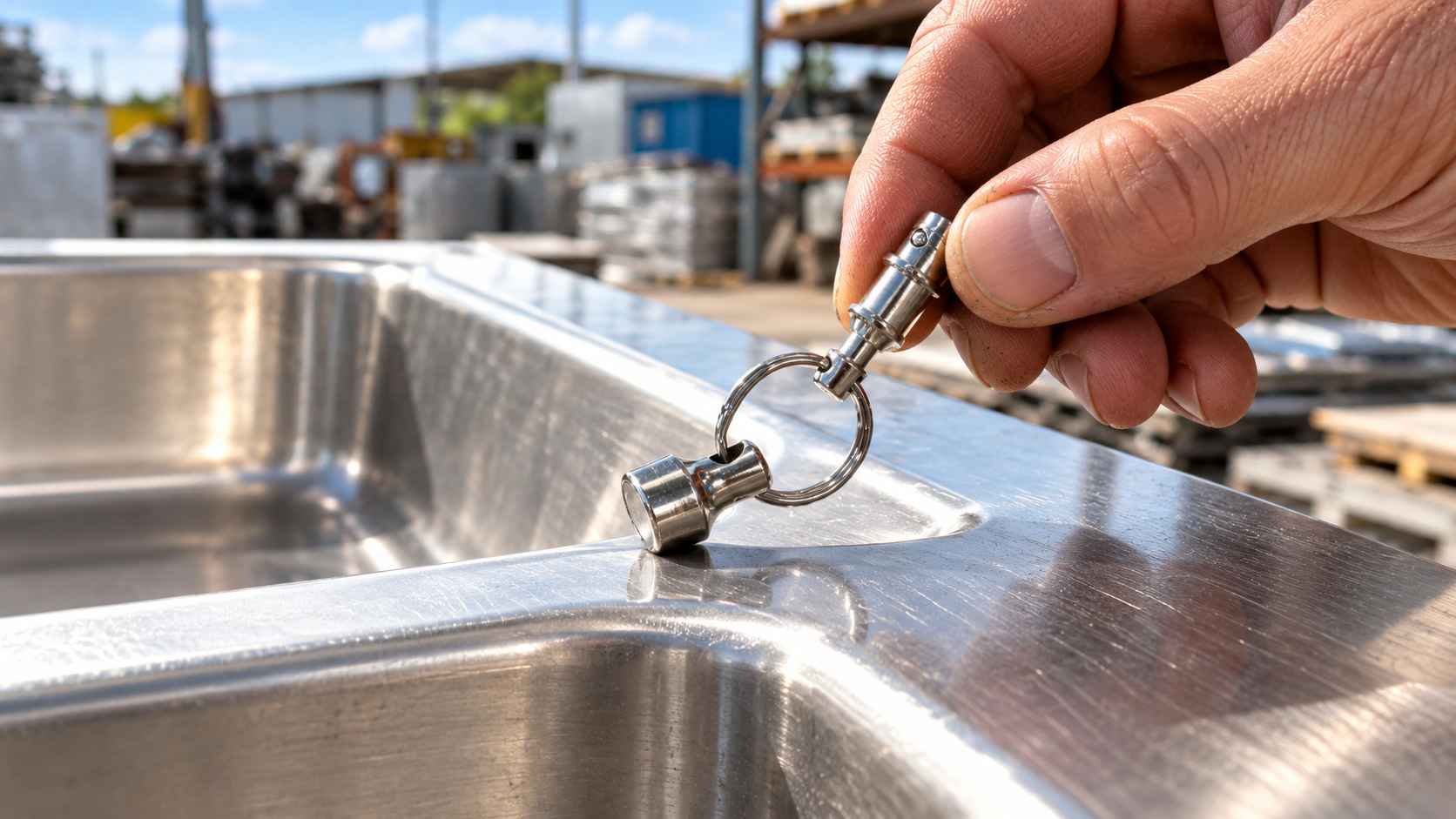
You’ve pulled out an old kitchen sink, grabbed a magnet to check whether it’s stainless and… the magnet stuck.
So, is it actually stainless?
Quite possibly.
Is stainless steel magnetic? It sounds like it should have a simple yes or no answer, but it depends on the type of stainless you’re dealing with. Some isn’t magnetic at all, some is strongly magnetic, and even common 304 stainless can sometimes give you a slight pull from a magnet.
Here’s what the magnet test can actually tell you, how 304 and 316 stainless differ, and what to look for before you bring stainless into the yard.
So, is stainless steel magnetic?
The short answer is: some is and some isn’t.
The stainless we commonly see for recycling includes 304 and 316. These are both part of the 300 series of stainless steel and, in their normal state, they’re generally non-magnetic.
Then you’ve got 400-series stainless. Grades such as 430 and 410 contain a different mix of metals and a magnet can stick to them quite firmly. You’ll find these grades in things like some appliance panels, knife blades and cookware.
And just to make the magnet test slightly more confusing, 304 can sometimes become a little magnetic after it’s been bent, pressed, rolled or otherwise worked.
Try a magnet on an old stainless sink, for example. The flat part might give you nothing, while a formed or rolled edge gives you a slight pull.
That doesn’t suddenly make it ordinary steel.

Why is some stainless magnetic and some not?
All stainless steel contains iron.
The endless stainless steel glossary describes it as a corrosion-resistant alloy made from iron, chromium and nickel, with at least 10.5% chromium.
That chromium is important. It forms a very thin protective layer on the surface of the metal, which is what gives stainless its resistance to corrosion.
The magnetic part comes down to the grade and the structure of the metal.
304 and 316 stainless contain nickel and belong to the 300 series. These are the grades commonly used for things like kitchens, food processing, plumbing, marine applications and fabrication.
400-series stainless, including grades such as 430 and 410, contains little or no nickel. These grades are magnetic and generally don’t have the same corrosion resistance as 304 or 316.
So a magnet sticking doesn’t automatically mean you’ve got fake stainless or ordinary steel.
It might simply be a different grade.
Is stainless steel ferrous or non-ferrous?

This is where the terminology gets a little messy.
Technically, stainless steel is an iron alloy, so it’s ferrous.
In metal recycling, though, stainless grades such as 304 and 316 are handled and valued separately from ordinary heavy and light steel because of the other metals they contain, particularly nickel and, in the case of 316, molybdenum.
That’s why you may sometimes hear stainless grouped with higher-value non-ferrous metals in the recycling industry even though, chemically speaking, it contains iron.
At endless, stainless has its own grades on our steel recycling page and is listed separately from ordinary heavy and light steel.
How to do the magnet test
You don’t need anything clever. A decent fridge magnet or small workshop magnet will do.
The important bit is to test more than one spot.
If there’s no magnetic pull anywhere, you could be looking at 304 or 316 stainless. But don’t stop there. Aluminium isn’t magnetic either, so have a feel for the weight. Stainless should feel considerably heavier than aluminium of a similar size.
If there’s a slight pull around a bend, weld or formed edge, but little or nothing across the flat surface, it could still be 304 stainless. Working the metal can make those areas slightly magnetic.
If the magnet grabs firmly everywhere, but the material still looks like stainless and shows good corrosion resistance, you may have a 400-series stainless grade.
And if the magnet grabs strongly and you’re seeing rust, flaking or a shiny surface that’s starting to come away, there’s a good chance you’re looking at plated ordinary steel rather than stainless.
There are a couple of other clues worth checking too.
Look for a stamp or marking. Commercial stainless is often marked 304, 316, 18/8, 18/10 or something similar. Cookware and cutlery, in particular, often have useful markings underneath.
You can also look closely at the surface. Chrome-plated steel has a thin outer finish over a different base metal. Stainless is the same material all the way through.
One test we don’t recommend doing at home is taking a grinder to it and trying to identify the metal from the sparks. You need the right equipment, eye protection and enough experience to know what you’re looking at.
There’s no need. We grade stainless at the yard anyway.
304 vs 316 stainless steel: what’s the difference?
This is the distinction that’s more likely to matter when your stainless is being graded.
304 stainless is the everyday workhorse.
It’s widely used in kitchen sinks, benchtops, commercial kitchen equipment, cookware, cutlery, handrails, pipe, sheet and general fabrication. You’ll also sometimes see it described as 18/8, referring to its approximate chromium and nickel content.
It’s one of the stainless grades we see regularly coming across the weighbridge.
316 stainless contains molybdenum as well as chromium and nickel. That gives it greater resistance to corrosion, particularly around salt water and harsher environments.
That’s why you’re more likely to find 316 in marine fittings and hardware, coastal installations, food and dairy processing equipment, pharmaceutical equipment, and chemical or water-treatment pipework and fittings.
316 is generally a more valuable recycling grade than 304 because of that different metal content.
Here’s the catch.
You can’t reliably tell 304 vs 316 stainless steel with a magnet.
Both are generally non-magnetic and they can look virtually identical.
If you’ve got markings, specifications or you know where the material came from, tell us. Stainless removed from a marine installation or food-processing plant, for example, gives the team useful context when it’s being graded.
If you don’t know, that’s fine too. We test and grade stainless on site.
How stainless is graded at endless
Stainless isn’t all thrown into one pile.
The grades listed by endless include Stainless Steel 304, Stainless Steel 316, 304 Swarf, 316 Swarf and Irony Stainless.
Clean 304 might include things such as stainless sinks, sheet, pipe, benches and fabrication offcuts.
316 is commonly associated with marine, food-processing and industrial applications.
Swarf is the turnings and shavings produced when stainless is machined, and it’s kept separate from solid stainless.
Then there’s Irony Stainless. This is stainless that still has steel or other attachments on it, or material where contamination affects the grade.
Every load is assessed when it arrives. What you’ve got attached to the stainless can make a difference.
A bit of sorting before you arrive can help
This doesn’t need to become a weekend project.
But if you’re already handling the material, a few simple things are worth doing.
If you know you’ve got 316, keep it separate from your 304. That might be because it’s stamped, you’ve got the specifications, or you know exactly what installation it came from.
Don’t mix it back together after you’ve gone to the trouble of identifying it.
Take off obvious attachments where they’re easy to remove too. Steel brackets and legs, plastic, rubber seals, timber, sink wastes and tapware don’t need to stay attached to the stainless.
Brass is another metal grade entirely, so if you’ve removed brass fittings, keep those separate as well.
Most importantly, don’t throw good stainless into your ordinary steel pile.
Stainless and steel might look similar at a glance, but they’re not the same recycling grade. Mixing everything together makes it harder to identify and grade what you’ve actually got.
If you’re producing stainless swarf through machining, keep the different stainless grades separate rather than mixing them with each other or with ordinary steel swarf.
And remember that something having a stainless-looking outer surface doesn’t necessarily make the whole item stainless scrap.
A fridge, dishwasher or oven, for example, is still whiteware rather than a clean stainless grade.
Where does stainless turn up?
Auckland homes produce plenty of it. Kitchen sinks, splashbacks, pots and pans, cutlery, BBQ components and balustrades are common examples.
Hospitality fit-outs can produce commercial benches, shelving, sinks and extraction canopies.
For plumbers and fabricators, it’s pipe, fittings, sheet, tube and offcuts. Engineering businesses can also generate stainless swarf through machining.
Marine work is another obvious source, particularly fittings, rails and hardware.
Then you’ve got larger industrial applications. Tanks, pipework, valves and fittings from food, dairy, brewing, pharmaceutical and other processing environments can all contain stainless.
If you’re a tradie bringing metal in regularly, our Tradie Legends programme includes stainless among its eligible metals.
For businesses generating larger or ongoing volumes, have a look at our commercial metal recycling service too.
Check the current rate before you come in
Stainless values move with international metal markets, so there’s no point putting a dollar-per-kilo figure into this article that could be wrong next week.
Check the current pricing for the yard you’re actually heading to instead.
For Onehunga, use the Onehunga live pricing page. You’ll find the yard at 147 Neilson Street. Check the Onehunga yard page for the latest opening information before you visit.
If you’re heading to Wairau Valley, use the Wairau Valley live pricing page. The yard is at 245 Archers Road, with current visitor information on the Wairau Valley yard page.
If you’ve got material you believe is 316 and you’re heading to Wairau, call us on 0800 44 88 99 first and we’ll confirm the best way to handle it.
There’s no appointment or minimum load needed at either yard.
You’ll need to bring your NZ driver’s licence or passport when you sell metal to us, as endless is required to record seller identification.
And if you’re still standing there with a magnet stuck to your kitchen sink wondering what on earth you’ve got?
Bring it in.
We’ll test it.