If you’ve spent any time in the scrap metal industry, or you’re just starting to figure out what that pile of old plumbing fittings and electrical cable in your garage is actually worth, then you’ve probably heard the term red metals. It’s one of those phrases that gets thrown around at scrap yards and recycling depots across Auckland without much explanation, and yet understanding it properly could mean the difference between leaving money on the table and walking away with a genuinely solid payout.
Regardless if you’re a residential, tradie, commercial or demolition customer, we have all the resources to ensure you get the best bang for your buck on red metals.
So what exactly are the red metals? Why do Auckland scrap metal dealers and recycling yards get so excited when you bring them in? And how do you identify what you’ve got before you load up the ute and head in?
This guide breaks it all down, metal by metal.
What Are Red Metals?
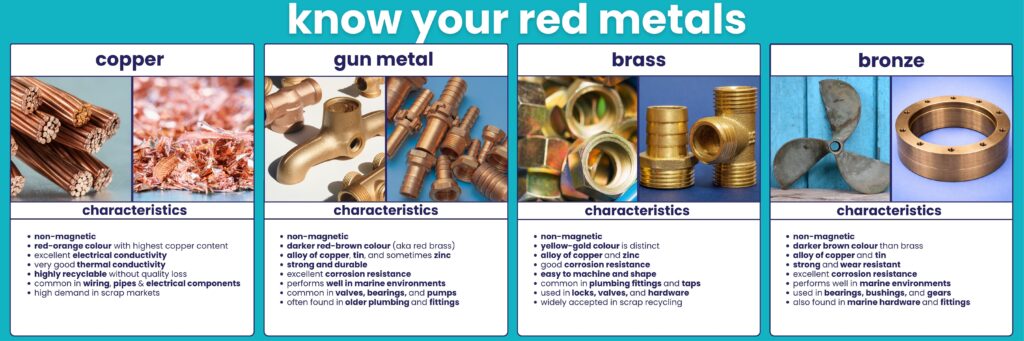
The term “red metals” refers to a family of non-ferrous metal alloys that share a common base: copper. Because copper itself has that distinctive reddish-orange colour, and because its most common alloys, brass, bronze, and gunmetal, carry variations of that same warm, reddish-brown tone, the industry groups them together under one umbrella.
Red metals are among the most sought-after materials at scrap yards throughout Auckland and across New Zealand. They are non-ferrous, meaning they contain no iron and therefore don’t rust in the traditional sense. They are dense, durable, and highly recyclable. Unlike some materials that degrade through the recycling process, red metals can be melted down and reprocessed repeatedly without any meaningful loss of quality. That’s a big deal both economically and environmentally.
With Auckland’s construction sector, infrastructure projects, and industrial base generating significant volumes of scrap material every year, red metals flow through the city’s recycling network in substantial quantities. Whether you’re a tradesperson, a demolition contractor, a property developer, or simply a homeowner clearing out decades of accumulated plumbing and electrical gear, understanding red metals is genuinely useful knowledge.
Copper: The King of the Red Metals
If there’s one metal that scrap dealers across Auckland will always want to see, it’s copper. Pure copper sits at the top of the red metals hierarchy, and for good reason.
Copper’s value in the scrap market comes down to one thing above all others: its exceptional electrical conductivity. It is one of the best conductors of electricity available, which makes it irreplaceable in the manufacture of electrical wiring, motors, transformers, generators, and a vast array of electronic components. As the world pushes harder toward electrification, electric vehicles, renewable energy infrastructure, smart buildings, the global demand for copper continues to climb. That demand filters directly down to the scrap market, keeping copper prices strong.
In Auckland specifically, copper scrap turns up in a wide variety of forms. Electrical cable and wire is one of the most common, including old building wiring, industrial cable, telecommunications cable, and automotive wiring harnesses. Copper pipe and tube from plumbing systems is another major source, particularly from older homes and commercial buildings undergoing renovation or demolition. Copper roofing, guttering, and flashing from heritage buildings also makes its way into the scrap stream, as does copper from heat exchangers, radiators, and air conditioning systems.
Understanding of Copper:
The key thing to understand about copper is that grade matters. Bright, clean copper wire with no insulation commands a significantly higher price than insulated wire or contaminated copper. Most Auckland scrap yards will grade your copper on the spot and price it accordingly, so it pays, literally, to strip and clean your material before you bring it in if you have the time and tools to do so.
Copper is also highly recyclable without quality loss, meaning the copper that gets melted down at a recycling facility today is just as good as newly mined copper. This makes it not only economically valuable but genuinely important from a sustainability standpoint. Recycling copper uses a fraction of the energy required to mine and process virgin copper ore, a fact that matters increasingly to Auckland businesses and consumers who are thinking about their environmental footprint.
One more thing worth noting: copper is non-magnetic. If you’ve got a magnet handy, that’s one of the quickest ways to confirm what you’re looking at. Copper won’t attract it at all.
Brass: The Everyday Workhorse
Walk through any older Auckland home, commercial building, or industrial facility and you’ll find brass everywhere. You just might not have been looking for it. Brass is one of the most widely used alloys in construction and manufacturing, and it’s one of the most commonly recycled red metals at Auckland scrap yards.
Brass is an alloy of copper and zinc, and its distinctive yellow-gold colour makes it relatively easy to identify once you know what you’re looking for. It’s harder and more durable than pure copper, which is why it became the go-to material for so many practical applications. Like all red metals, brass is non-magnetic, which helps when you’re sorting through a mixed pile of hardware.
In terms of scrap sources, brass turns up in plumbing fittings and taps, including the threaded fittings, ball valves, gate valves, and tap bodies that connect pipes throughout a building. Locks and door hardware are another major source: deadbolts, padlocks, hinges, handles, and escutcheons are frequently brass. Electrical components including terminals, connectors, and switchgear often contain brass. Radiator cores from older vehicles, musical instruments, cartridge casings, and a huge range of industrial valves and fittings round out the picture.
For Auckland homeowners doing bathroom or kitchen renovations, or tradespeople replacing plumbing systems in older properties, brass accumulates quickly. Rather than sending it to landfill, bringing it to a local Auckland scrap metal recycler is the smarter move, both financially and environmentally.
Brass is widely accepted at scrap yards throughout Auckland, and while it commands a lower price per kilogram than clean copper, it’s still a valuable material. Mixed brass, clean brass, and brass turnings from machining operations may be priced differently, so it’s worth asking your local dealer how they grade it.
Gunmetal: The Underrated One
Of the four red metals, gunmetal is probably the least well known among the general public. But among experienced scrappers and tradespeople in Auckland, it’s a recognised and valued material.
Gunmetal, sometimes called red brass, is an alloy of copper, tin, and often zinc. Its colour is a darker red-brown than either pure copper or standard brass, which can help with identification. Historically, it was used to cast cannons (hence the name), but in modern applications it’s found predominantly in older plumbing systems, particularly the heavy, robust fittings found in commercial and industrial buildings constructed in the mid-twentieth century.
In Auckland’s built environment, gunmetal turns up in valves, pumps, bearings, and pipe fittings, especially in older infrastructure. If you’re working on a demolition or refurbishment project in an older Auckland industrial building, warehouse, or commercial property, there’s a reasonable chance some of the heavy plumbing hardware you’re pulling out is gunmetal rather than standard brass.
Because it contains a higher proportion of tin than regular brass, gunmetal is exceptionally durable and corrosion-resistant, which is why it was used so extensively in demanding applications. That same durability means it retains its value well in the scrap market. Auckland scrap dealers who know their metals will identify and price gunmetal correctly, though it’s always worth pointing it out if you believe that’s what you have, particularly if you’re bringing in a significant quantity.
Like all red metals, gunmetal is non-magnetic and performs exceptionally well in marine environments, making it a material you’ll encounter regularly in Auckland’s busy port and marine sector.
Bronze: Built to Last, Worth Recycling
Bronze is one of humanity’s oldest alloys and it remains one of the most practically useful materials in modern industry. An alloy of copper and tin, bronze has a darker brown colour than brass and a noticeably different weight and texture.
What makes bronze special is its combination of properties: it is extremely strong, highly wear-resistant, and offers excellent corrosion resistance, including in marine environments. That last quality is particularly relevant in Auckland, a city built around the Waitematā and Manukau harbours, with a massive recreational and commercial marine sector.
Bronze is the material of choice for marine hardware and fittings. Propellers, through-hull fittings, seacocks, cleats, and deck hardware on boats and ships are frequently made from bronze precisely because it stands up to saltwater exposure without corroding. For Auckland’s boating community, this means that end-of-life vessels and marine equipment can yield significant quantities of valuable bronze scrap.
Beyond marine applications, bronze is widely used in industrial bearings, bushings, and bushes, the wear components inside machinery, pumps, and engines that need to handle friction and load over long periods. Gears, worm wheels, and other precision components in industrial equipment are often bronze. Architectural bronze, used in heritage buildings, monuments, plaques, and decorative elements, also makes its way into the scrap stream over time. For Auckland businesses in manufacturing, engineering, marine industries, and construction, bronze scrap is a regular byproduct of operations. Recycling it through a reputable Auckland scrap metal dealer ensures it re-enters the materials supply chain rather than going to waste.
Why Red Metals Matter for Auckland’s Recycling Economy
The red metals aren’t just valuable. They’re strategically important. New Zealand imports the vast majority of its refined metals, which means that every kilogram of copper, brass, bronze, or gunmetal that gets recycled domestically is a kilogram that doesn’t need to be mined, refined, and shipped from overseas. In a country that takes its environmental commitments seriously, the scrap metal recycling industry plays a genuinely meaningful role.
For Auckland specifically, as New Zealand’s largest city, its biggest construction market, and its primary industrial hub, the volume of red metal scrap generated annually is substantial. Keeping that material in the recycling loop, rather than sending it to landfill or letting it sit unused in sheds and workshops, is good for the environment, good for the economy, and good for the businesses and individuals who take the time to sort and sell it properly.
A useful rule of thumb across all four red metals: none of them are magnetic. If you’re unsure whether what you’ve got is a red metal or a ferrous material like steel or cast iron, a simple magnet test will tell you immediately. Red metals won’t attract it. That one tip alone can save a lot of confusion when you’re sorting through a mixed load before heading to your Auckland scrap yard.
Getting the Best Price for Your Red Metals in Auckland
A few practical tips before you head to your local Auckland scrap yard:
- Separate your metals. Don’t mix copper, brass, and bronze together if you can help it. Sorted material consistently gets better prices.
- Clean your copper. Stripped, insulation-free copper wire commands a premium over insulated wire.
- Know your grades. Ask your dealer to explain how they’re grading your material. A good Auckland scrap dealer will be transparent about this.
- Bring volume when you can. Larger quantities of clean material will always attract better rates.
- Build a relationship. If you’re a tradesperson or contractor generating scrap regularly, finding a reliable Auckland scrap metal recycler and building an ongoing relationship is well worth the effort.
To read more about getting the best dollar value for your scrap, please read – “Auckland Scrap Metal Recycling: How To Scrap Metal for Cash”
Red metals are valuable, recyclable, and in demand. Whether you’ve got a handful of old brass fittings or a ute full of copper cable, Auckland’s scrap metal recycling industry is ready to put it to good use.
To ensure that you have a full understanding of scrap metal terminology, make sure you check out or brand-new scrap metal glossary!